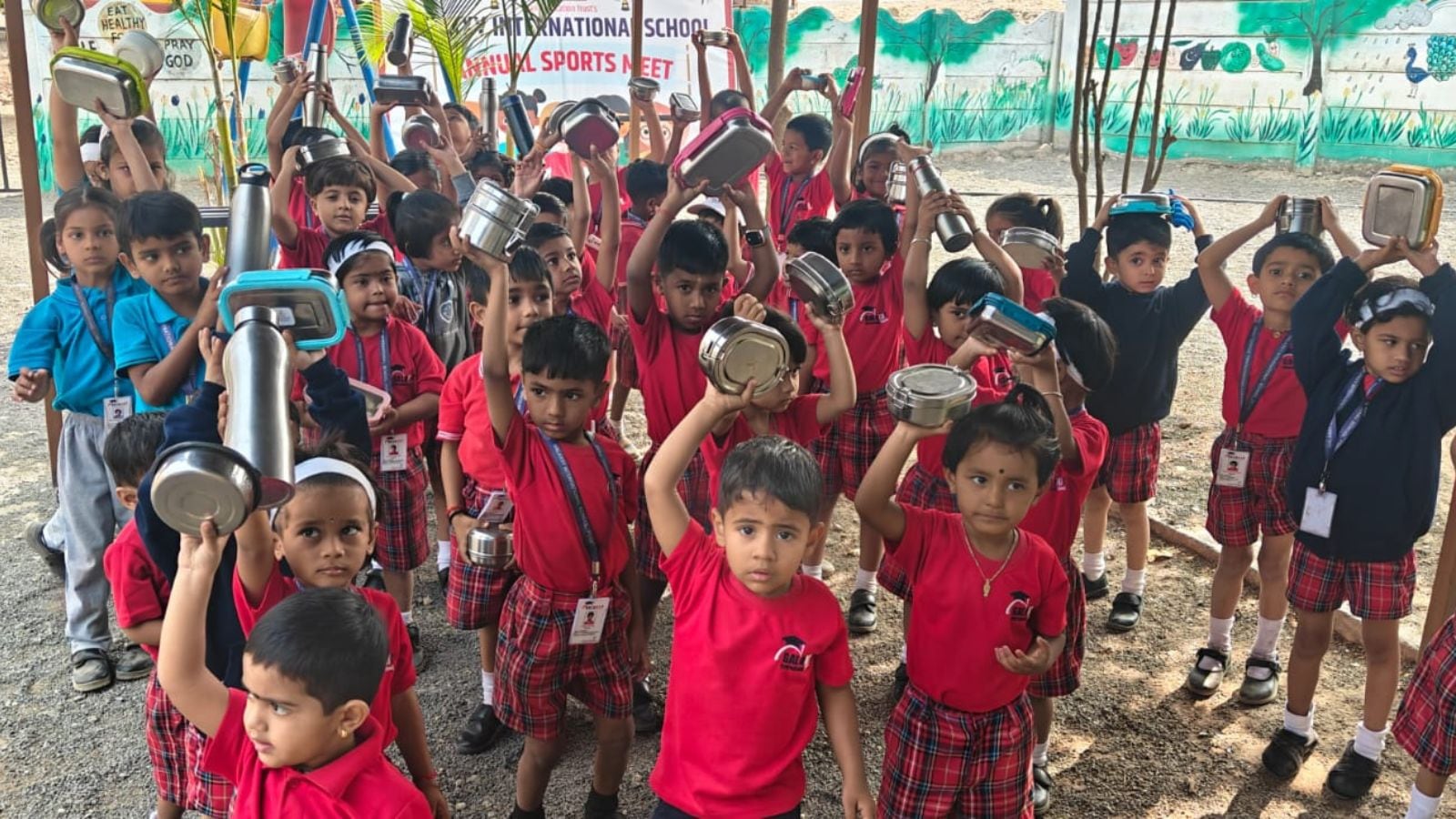
The colorful plastic boxes, popular with children and parents, could soon become a thing of the past, starting with Pune.
On February 4, the commitment to reject plastic lunch boxes was echoed on the grounds of 104 schools. “I am committed to reducing waste in our daily lives. Starting June 2026, we will regularly carry lunch in a steel tiffin instead of a plastic one. A steel tiffin is a symbol, not just a box, and reminds us that our small actions matter. We will inspire our family and friends, so Pune can lead the way for India,” the children declared, as teachers and staff took oath.


Steel Tiffin Pledge, involving 56,000 students, is an initiative of the Center for Sustainable Development, based at the Gokhale Institute of Politics and Economics. The campaign aims to reduce waste at source by keeping plastic (particularly materials that leach microplastics) out of children’s food and water.
“The steel tiffin has been adopted as a symbol of individual action creating collective impact,” says Aditi Deodhar, who is spearheading the campaign. The pledge is part of Mission City Chakra, which “turns off the waste tap in the city by empowering middle-level policymakers to implement large-scale waste reduction measures.” “For school principals, children’s health is an immediate priority, so they do not hesitate to join in,” says Deodhar.
Vanaz Parivar Vidya Mandir in Kothrud was one of the first to adopt this practice as part of a pilot project in 2024. “I approached our school society, which immediately gave us the green light. On Republic Day, our committee members, school children, teachers and many parents took oath,” says Anita Darwatkar, principal of Vanaz Parivar Vidya Mandir.
The school later held a parent-teacher meeting to discuss the initiative. “Some parents would say, ‘Madam, yeh steel to bahut mehenga hota hai aur phir bachche guma dete hain (Madam, steel is very expensive and children also lose boxes),’” Darwatkar recalls. To address this, the school introduced a day when all tiffin boxes found on campus were put on display for children to claim. Darwatkar also explained to parents the increased health cost of exposing children to microplastics in food.
Ask any student about plastic and the answer is immediate: “Microplastics cause many diseases, including cancer.”
Jay Avinash Mohol, a Class V student, says, “Plastic ka dabbha lane se log bimar padte hain isliye aap sabko steel ka dabbha istemal karna chahiye (If people use plastic tiffins, they get sick, so we should use steel).” Ayush Gaekwad, also from Class V, has urged his parents to reduce the use of plastic. Anushree Ugalmogale has switched from plastic to steel for both her tiffin box and her water bottle. Ali Rahim Sheikh, a Class IV student, says his chapati and bhaji are kept fresh in a steel box.
Story continues below this ad.
Some children point out that steel tiffins leak, so they wrap them carefully to protect their books. The school, which won an award from a social organization for going plastic-free, achieved 100 percent participation, with its 680 students carrying only steel boxes.
The problem of plastic waste is well documented. According to the United Nations, “Every day, the equivalent of 2,000 garbage trucks full of plastic is dumped into the world’s oceans, rivers and lakes. Every year, between 19 and 23 million tons of plastic waste leak into aquatic ecosystems, polluting lakes, rivers and seas. Plastic pollution can alter habitats and natural processes, reducing the ability of ecosystems to adapt to climate change, directly affecting the livelihoods of millions of people. people, food production capacities and social conditions,” says the United Nations Environment Programme.
However, plastic boxes remained an invisible source of pollution even among environmentally conscious families carrying cloth bags. “We realize that there are policymakers at various levels of society. Instead of approaching Bombay either Delhi “To bring about change, we can approach these policymakers, and one of them is the school principal,” says Deodhar. “From five years old to 15 years old, every day, children eat lunch in plastic boxes and drink water in plastic bottles. We appealed to principals that, just as schools have uniforms, they should have mandatory steel boxes and bottles.”
The program began as a pilot with three school principals whom Deodhar knew through his work with Jeevitnadi, an organization working for river rights. The February commitment marks a commitment to the mission for the new academic year.
Story continues below this ad.
At Katraj’s LS Jadabai English School, principal Vaishali Mohite has long been talking to students about the dangers of plastic boxes. “In summer, when the days become warm, the plastic also heats up. It enters their food and their bodies, endangering their health,” he says. The school’s 850 students have pledged not to use plastic tiffin boxes or plastic water bottles.
Srihari Suthamally, a software engineer whose daughters, ages 15 and nine, study at the DriveChange Learning and Resource Center, supports the initiative. A former student of the Ecological Society, he already follows the principles of reject, reduce, reuse and recycle. The family uses steel tiffin boxes even when buying idli or poha outside.
“My two daughters carry two boxes each. We pack chapati and dal, and as South Indians, we eat a lot of rice – lemon rice, coconut rice and curd rice. For breakfast, we give them dry snacks or sandwiches. The food is not too hot and tiffin boxes are suitable,” he says.
After conducting 200 sessions with students, Deodhar says adults often underestimate children. “Parents think that children want colorful or cartoon tiffin boxes. When we talk to children, I tell them the story of the river and the challenges we face. They understand that plastic is the problem because it is abundant in rivers. We agree that plastic is a problem because it does not decompose and degrades into microplastic. Then comes the commitment of children to use steel utensils because this is under their control. Awareness now flows from children to parents, that is our observation,” he says.