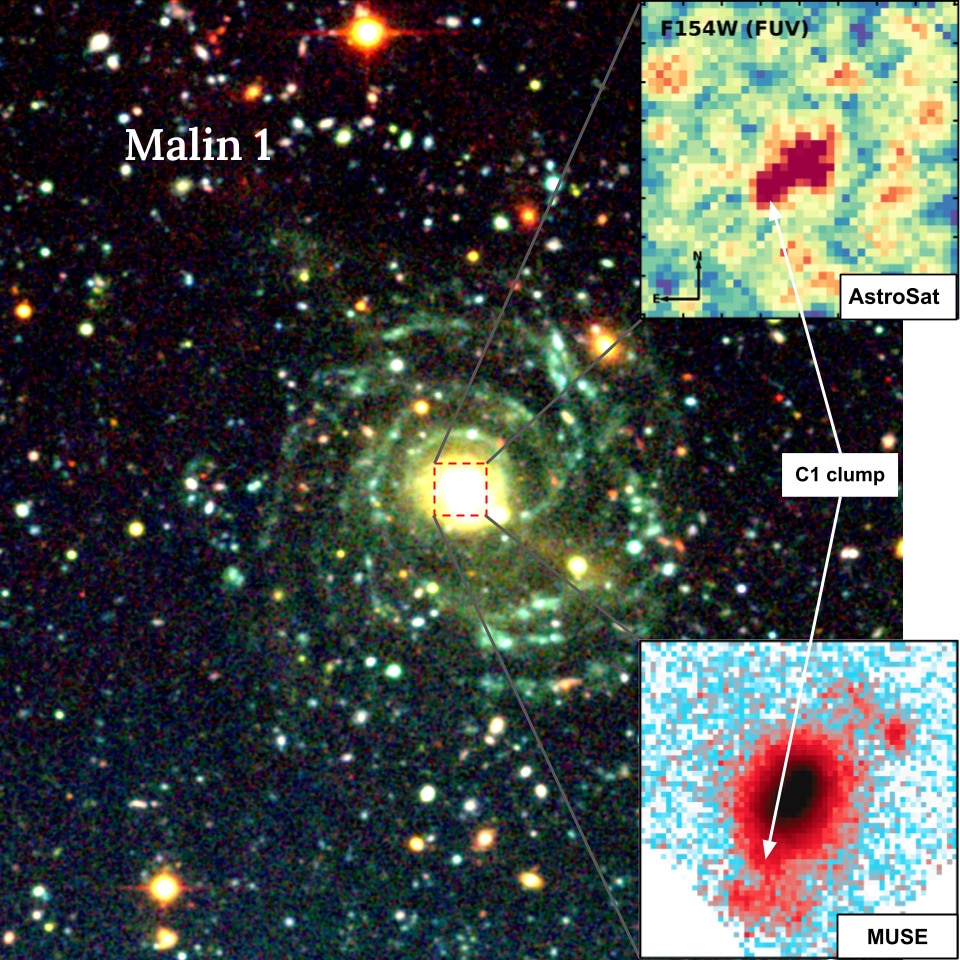
A study by a team of scientists from the Inter-University Center for Astronomy and Astrophysics, located in Pune, shows how Malin 1, the largest known low surface brightness galaxy, is silently cannibalizing dwarf galaxies.
Malin 1 has continued to puzzle astronomers since its discovery. In an official statement issued in Pune, IUCAA authorities said that while observing Malin 1 with the Ultraviolet Imaging Telescope (UVIT) on board AstroSat, the team identified a number of young star-forming clusters in its central region.
Manish Kataria, lead author of the paper, is a PhD student under the supervision of Professor Kanak Saha at IUCAA.
“Understanding how giant low surface brightness (GLSB) galaxies like Malin 1 grow is crucial, as their huge, faint structures challenge existing galaxy formation theories,” Kataria said in the statement.
Since the central region resembles a dim galaxy, meaning star formation has largely ceased, the presence of this bright cluster of ultraviolet rays was surprising and prompted the team to investigate further, the researchers said.
Study uncovers hidden evidence of subtle mergers, shedding light on the galaxy’s continued growth. The findings were published in the Letters from astrophysical journals in December 2025.
According to the official statement, using integral field spectroscopic observations from the Multi-Unit Spectroscopic Explorer (MUSE) instrument on the Very Large Telescope (VLT) in Chile, the researchers found that the C1 group moves approximately 150 km/s faster than the surrounding material and exhibits high turbulence.
“This is unexpected, given that the central region is dim, settled, and appears undisturbed. Furthermore, the C1 cluster appears only in certain velocity channel maps, strongly suggesting that it has an external origin, likely a dwarf galaxy that is being cannibalized,” the researchers said in the statement.
Using detailed modeling of the stellar population of MUSE spectra, the team performed a sort of archeology of the C1 group and the rest. Below the C1 group is an ancient stellar population, more than 6 billion years old, with solar-like metallicity and low abundance of alpha elements. After a long quiescent phase, a burst of star formation occurred in the last 200 million years, producing UV-bright stars in the C1 group along with extremely metal-poor young stars.
Quick enrichment
This young population is highly alpha-enhanced, indicating rapid enrichment by core-collapse supernovae. The same pattern is observed in the other groups. Taken together, the chemical signatures and high velocities strongly suggest that the C1 group is the remnant of a dwarf galaxy free-falling into a polar orbit. This orbit likely allowed pristine gas, similar to that in the early universe, fuel for forming such young stars, to be delivered to Malin 1. The dwarf galaxy was divided into four or more parts, all sharing very similar ages and chemical properties.
Professor Saha, who supervised the project, remembers noticing the UV clusters several years ago while examining UVIT data from Malin 1 and speculating that they could be of external origin. “Thanks to MUSE integral field data and Manish’s careful analysis, this idea was confirmed: Malin 1 is silently cannibalizing smaller dwarf galaxies, a process that is transforming its central region,” Professor Saha said.
Scientists from IUCAA Pune discover the cannibalistic nature of Malin 1 | Pune News
Published on