4 minutes of readingPuneFebruary 3, 2026 03:30 pm IST
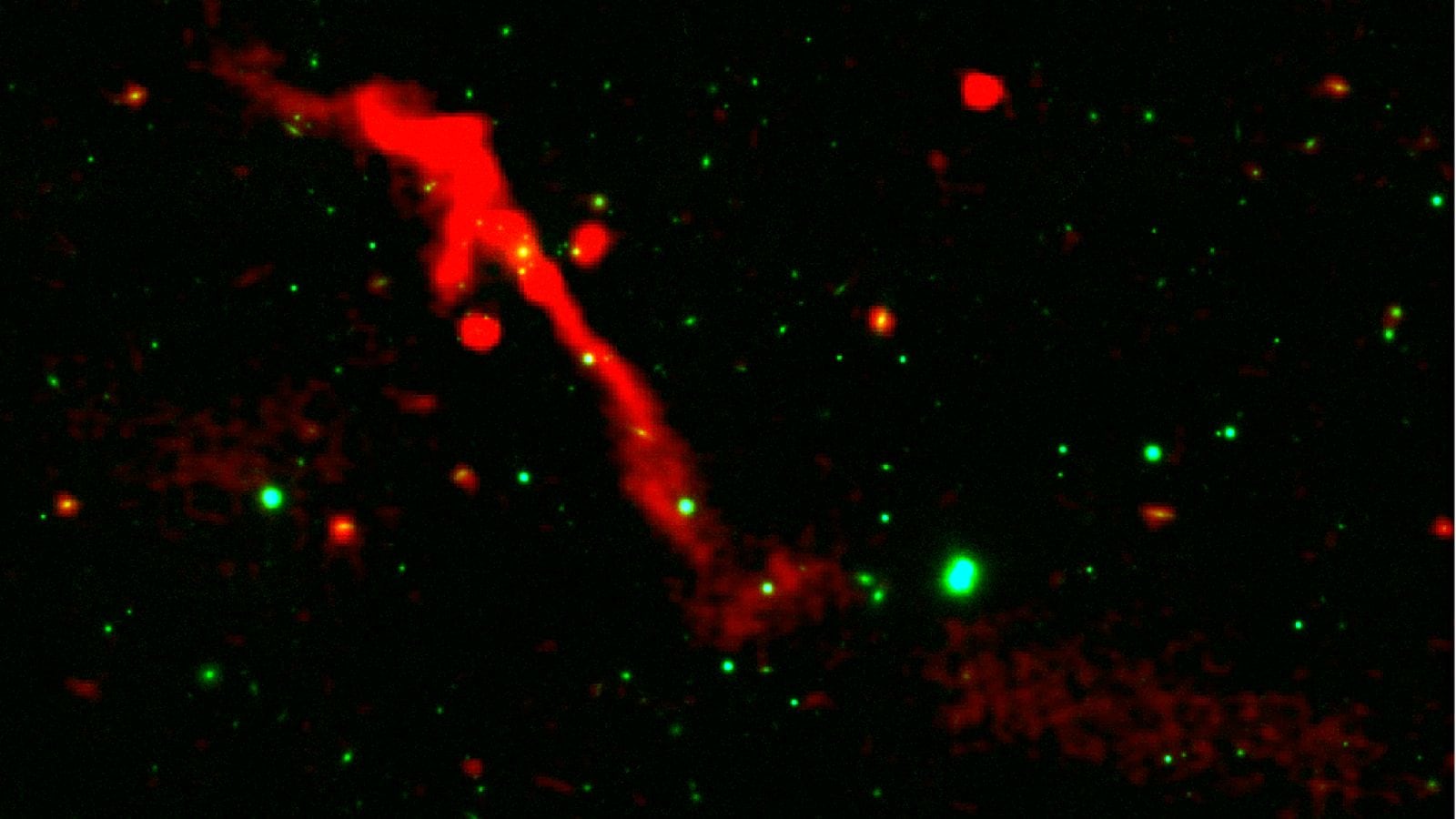
A rare ‘giant’ radio galaxy called J1007+3540 has been discovered by astronomers using some of the most powerful telescopes in the world, including the Giant Meter Wave Radio Telescope (uGMRT), located 80 km from Pune.
Using the unique low-frequency capabilities of the upgraded GMRT, operated by the National Center for Radio Astrophysics, dad Fundamental Research Institute, PuneThe team witnessed a monstrous black hole “wake up” after a silence of 100 million years.


The team of astronomers that captured this rare moment in cosmic history was led by Dr. Sabyasachi Pal, Associate Professor and Head of the Department of Pure and Applied Sciences, Midnapore City College, West Bengal, and principal investigator, along with Shobha Kumari, PhD student and senior author, and others.
The research was part of a global effort involving experts from India and Poland.
In addition to the lead authors, Dr. Surajit Paul from the Manipal Center for Natural Sciences in India and Dr. Marek Jamrozy from the Jagiellonian University in Poland also played a crucial role in the research. Their findings were recently published in Monthly Notices of the Royal Astronomical Society, a leading astronomy journal.
Galaxy 50 times wider than the Milky Way
“Our research shows how extreme cosmic pressure in a galaxy cluster is physically sculpting these new jets of energy,” Dr. Pal said. Astronomers explained that the galaxy is very gigantic and spans more than 3 million light years.
“To put this in perspective, it is 50 times wider than our own Milky Way. However, life in this galaxy is far from peaceful. It is located in the middle of a ‘galaxy cluster’, a crowded neighborhood filled with scorching gas. This gas creates immense pressure, acting like a heavy atmosphere that tries to crush everything within it,” Dr. Pal added.
Story continues below this ad.
By studying radio waves emitted by this galaxy, scientists said the images reveal a “double-double” structure (a pair of jets of bright new energy nested within much older, fainter ones), showing that the central black hole has recently reignited after a long period of silence. As these new jets take off, they become caught in a struggle with their surroundings; The intense pressure of the hot gas in the galaxy cluster is actually pushing the jet plasma sideways, creating striking curved shapes.
“This hostile environment has not only distorted the ancient plasma, but is also removing material from the galaxy as it moves, leaving behind a faint trail millions of years old known as a ‘galactic wake’. This galaxy is not only growing; it is fighting to survive,” Dr. Pal explained. It acts as a natural laboratory for scientists to see how black holes turn on and off and how they shape the universe around them. Astronomers said it was ‘a violent and beautiful tug of war’ between the power of a black hole and the crushing weight of deep space.’
Low-frequency Band 3 (250-500 MHz) imaging of J1007+3540 using uGMRT helped track the extended diffuse emission, showing the large-scale tail as well as the internal episodic jet and associated distorted outflow structures. The uGMRT image was further used to study the spectral properties of the source. In particular, the spatial distribution of the spectral index for different parts of the structure helped to understand the nature of radio emission aging in a particular region.
By studying this unique system, scientists can finally observe the full life cycle of supermassive black holes, from how they light up to how they go silent and finally “wake up” again.


Click here join WhatsApp Express Pune Channel and get a curated list of our stories
© The Indian Express Pvt Ltd