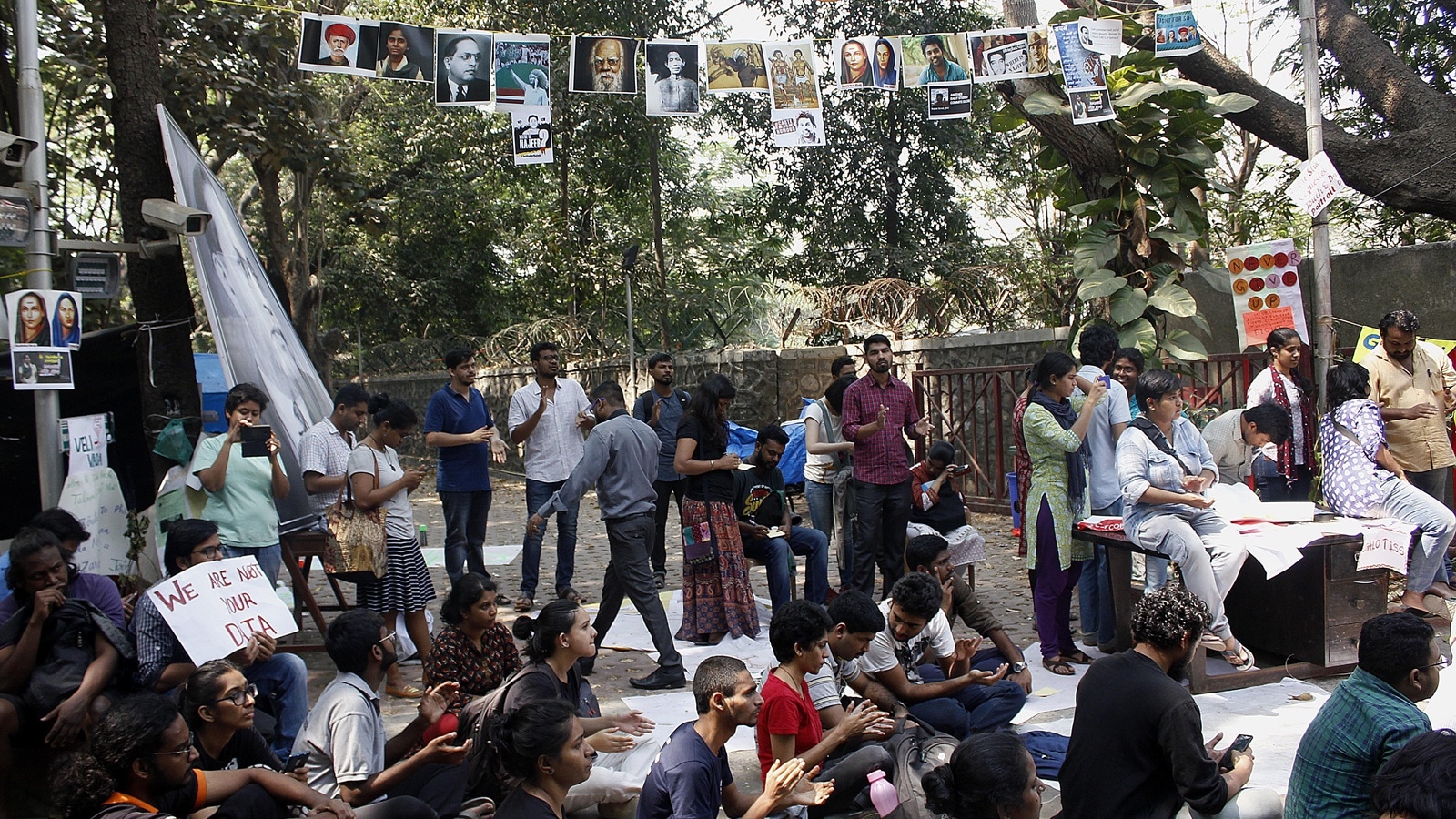

University politics at the Tata Institute of Social Sciences (TISS) is being fundamentally reshaped this year, with the administration implementing changes that replace the Students’ Union with a Students’ Council, introduce a mandatory apolitical membership pledge for candidates, and remove student representatives from key decision-making bodies.
Student body elections are back to TISS Bombay campus after being suspended for a year, during which the administration reviewed the Statutes of the Student Union, the regulations governing student elections and the operation of the union. The elections will be held on February 6.
The changes, however, have sparked pushback from student groups, who say they significantly reduce the role of student representatives in institutional decision-making and shaping their own elected bodies.
For starters, the title of the document was changed from Constitution of the Students’ Union to Constitution of the Students’ Council, effectively replacing the original model of the Students’ Union at TISS Mumbai. Previously, an executive body of seven members was elected for these positions, including the president, vice president and general secretary. Currently there is no executive body with such positions. In its place, a Student Council will be formed, comprising representatives, one from each class of each program taught on the Mumbai campus. This has raised concerns among students that the absence of an executive body of elected members will result in a dilution of students’ representative powers, especially in important administrative bodies.
Second, elected student representation in key institutional bodies, such as the Academic Council, the Disciplinary Committee and the General Complaints Committee, has been abolished, which students say significantly reduces the role of students in institutional decision-making. The Academic Council is the highest decision-making body on all important academic matters of a higher education institution. The Disciplinary Committee knows, among other matters, the files of disciplinary actions initiated against students. “In the previous practice, the president and the general secretary represented the students in these bodies. But the new statutes of the Student Council exclude this,” said a student who requested anonymity.
Under the new Student Council structure, the electoral process has been decentralized. Each class will elect one representative, and these representatives together will form a larger Student Council. Once elected, the council members will become part of different committees, such as finance, culture, literature and sports, through nomination by the institute’s administration. These nominations will be made by the Office of Student Affairs (OSA), which will also have the power to add unelected students to committees if it deems representation to be inadequate. The OSA will also appoint elected student representatives to important bodies such as the Gender Development Cell and the Equal Opportunities Cell. Student groups have argued that this expanded role of the OSA shifts decision-making power from elected representatives to the administration.
The revised rules introduce a new mandatory obligation for candidates, requiring them to declare that they are not affiliated with or represent any political party, organization or student wing. Previously, candidates only had to declare that they had no criminal record, that the information submitted was accurate, and that they would comply with election rules. The new format expands this to include statements that candidates have no political affiliations, face no pending disciplinary action, maintain minimum 75% attendance, and have no academic arrests. The undertaking also states that any false statement may result in the immediate cancellation of the candidacy. “In the old nomination process, other conditions were also considered, although not explicitly as part of the commitment. But it is absurd for the institute to ask students running for the student body election to declare that they have no political affiliation,” said one of the student candidates on condition of anonymity.
Story continues below this ad.
Amid controversy over the venture, students have also raised concerns about the lack of transparency in how the revised framework for student body elections was finalized. “After our objections, the administration has declared that the Student Council Statutes are only a draft and are subject to suggestions from students. But even before our suggestions are considered, the electoral program is already underway,” said one student, adding that they were given until 5 pm on Friday to submit suggestions for the revised Statutes, while the nomination process for the February 6 elections had already closed on Thursday.
Students have argued that if the proposed Constitution is still a draft, upcoming student body elections cannot be held under the revised framework. “But the institute management has not clarified anything about it,” another student added.
However, TISS Dean of Student Affairs Professor M. Mariappan clarified that this election will be held as per the new framework. “All suggestions aimed at strengthening the student council model will be considered,” he said.
Regarding the changes in the structure of the student body, the institute’s management insists that this is to ensure broader student participation. “Having a large student council with several committees, instead of a student union of only a few members, ensures decentralization of power along with more opportunities for a larger number of students to develop their personalities by participating in extracurricular activities. For example, having a sports committee will ensure that good sportsmen on campus can participate in various competitions. Their representation of TISS will bring recognition to the institute across a broader spectrum of talents,” said Professor Mariappan, refuting the students’ claims that they no longer They will be represented on the administrative bodies. “Students will be represented in all statutory bodies of the institution as necessary,” he said.
Story continues below this ad.
However, according to the institute management, the task is a routine process. Professor Mariappan said, “No one will be disqualified solely on the ground of engagement. This is just a precautionary measure so that students do not bring their political behavior into institutional function. The institute believes that the student candidates will understand that while discharging their duty as members of the student council in various committees they must ensure a solution-oriented approach to work together with the administration focusing solely on the welfare of the students.”