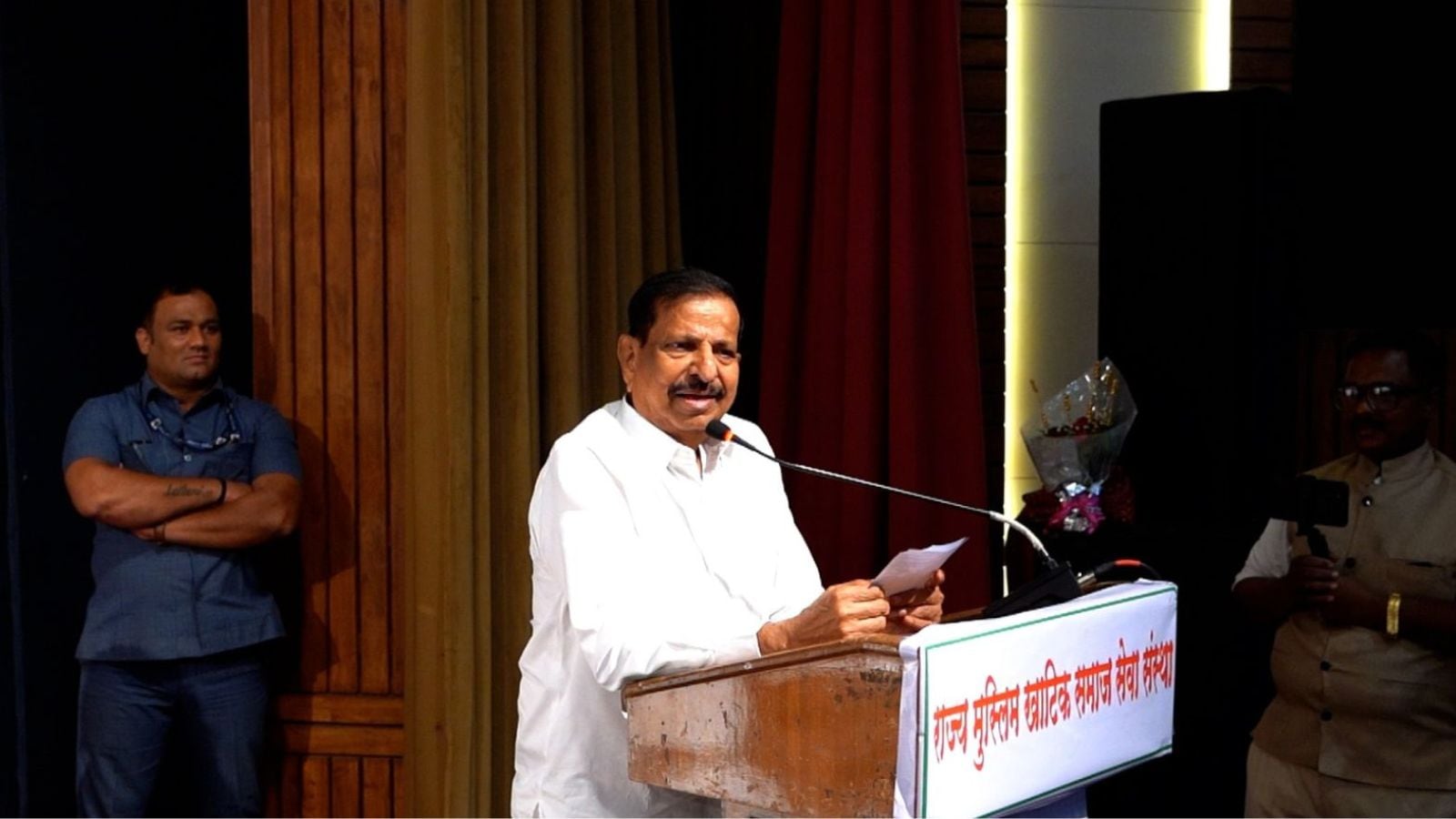
From warning that he would “bring down his chariot” to talking about “erasing his existence”, no leader in Maharashtra has attacked Deputy Chief Minister Eknath Shinde with as much venom as BJP MLA Ganesh Naik. While much of Naik’s rhetoric can be seen as political posturing in the ongoing power struggle between alliance partners BJP and the Shiv Sena, the hostility also has a deeply personal touch. It pits a leader once talked about as a potential Chief Minister against a former junior party colleague who rose, through rebellion and realignment, to the state’s top job.


Born in Bonkode, then a small village in present-day Navi. Bombay In the Agri community, Ganesh Naik emerged along with the rapid urbanization of the region driven by the Trans Thane Creek TTC MIDC industrial belt. He was one of the first local organizers to address labor grievances and civic issues as the area transformed from farmland to an industrial and residential center.
Naik entered public life early. As a teenager, he worked with Mathadi headloader unions and industrial labor groups throughout the TTC corridor. These labor networks became the foundation of his political base and coincided with the expansion of the Shiv Sena in Navi Mumbai in the late 1970s. It was during this period that Naik is believed to have forged links with one of India’s most prominent industrialists, a relationship that has lasted for decades. He later joined the Shiv Sena, becoming its main face in Vashi, Nerul, Airoli, Turbhe and Ghansoli.
Rise up in the Shiv Sena and break with the party
By the late 1980s, Ganesh Naik had firmly established himself in Navi Mumbai, but his rise within the Shiv Sena was marked by conflict. At that time, Navi Mumbai belonged to Thane district, where Anand Dighe dominated the party organisation. Initially, the two leaders operated in separate spheres, but as Thane and Navi Mumbai expanded, their political boundaries began to overlap, leading to increasing friction. Bal Thackeray finally intervened and informally demarcated Navi Mumbai as Naik’s area of influence.
Naik’s growing stature translated into electoral success in 1990, when he won the Belapur Assembly seat. After Shiv Sena’s BJP government came to power in 1995, he was inducted into the cabinet under Chief Minister Manohar Joshi. Around the same time, his name was also mentioned as a possible candidate for the post of Chief Minister. Naik has claimed in public speeches that several prominent industrialists favored him for the job and had conveyed this to Thackeray, although he has also said that he was not interested in the job at the time.
However, as a minister, Naik’s confrontational style soon brought him into conflict with both Joshi and the Sena leadership. He repeatedly disagreed with the Chief Minister on departmental issues and criticized him publicly, an unusual step in a party known for its strict internal discipline. When Naik refused to resign, Joshi removed him from the cabinet with Thackeray’s approval.
Story continues below this ad.
The rift also extended to local politics. Naik’s defiance and influence over civic institutions contributed to the Shiv Sena losing control of the Navi Mumbai Municipal Corporation in the late 1990s. At a time when the party was at the peak of its power, such an open rebellion was rare.
The final break came in 1999, when Naik joined Sharad Pawar’s newly formed Nationalist Congress Party. In the Assembly elections that year, he was defeated by the Shiv Sena, whose Thane unit was led by Anand Dighe, under whom Eknath Shinde then he emerged as a key organizer.
Political journey after leaving the Shiv Sena
After his defeat in 1999, Ganesh Naik kept a low profile for several years before returning in 2004 as a candidate for the Nationalist Congress Party. He returned to the government as Excise Minister and held several key portfolios over the next decade, strengthening his influence over Navi Mumbai’s civic administration and industrial network.
In 2014, Naik suffered a setback when he was defeated by Manda Mhatre of the BJP, a former associate who had leveled corruption allegations against him. The defeat, along with the BJP’s growing dominance in Maharashtra, gradually brought Naik closer to the party. He formally joined the BJP in 2019 and won the Airoli Assembly seat the same year.
Story continues below this ad.
However, his long rivalry with Eknath Shinde, dating back to the Anand Dighe era, meant that Naik was not included in the cabinet after the Shiv Sena split following the 2019 elections. It was only after Devendra Fadnavis When he returned as Chief Minister in 2024, Naik entered the ministry as Forest Minister of Maharashtra.
The BJP has since deployed Naik as a key political operator in the Mumbai Metropolitan Region, particularly in Thane, where Shinde’s organizational base remains strongest.
What explains the fight between Shinde and Naik?
Ganesh Naik’s sustained attacks on Eknath Shinde are largely seen to serve the BJP’s tactical interest in maintaining pressure on its ally and denying the Deputy Chief Minister a political respite. Naik’s role in this equation arises from his stature in the Mumbai Metropolitan Region and the fact that, unlike many regional leaders, he is neither dependent on nor politically intimidated by Shinde. With considerable financial resources and long-standing corporate ties, Naik does not hesitate to take on Shinde, who he believes has attempted to expand into his political stronghold of Navi Mumbai.
In the 1990s and early 2000s, Naik emerged as the undisputed face of the Shiv Sena in Navi Mumbai and later as guardian minister of Thane district. After Dighe’s death in 2001, Shinde inherited the Thane organization and gradually expanded its influence. Shinde’s rebellion and his rise as Chief Minister transformed him from a regional leader to a state authority with control over the government machinery, party organization and political patronage.
Story continues below this ad.
Historically, Naik had never operated under a Thane-based leader. While Shinde sought to further consolidate his bases, Naik saw it as a new attempt by Thane to invade his political backyard.
The BJP’s sweep in the Navi Mumbai Municipal Corporation, where it won 65 of the 111 seats under Naik’s leadership, has further strengthened its position. Shinde’s faction, on the other hand, has emerged as the junior partner in most urban local bodies even as it seeks to increase its influence within the alliance.
Meanwhile, the BJP appears to have given Naik a free hand for now as it continues to attack Shinde.