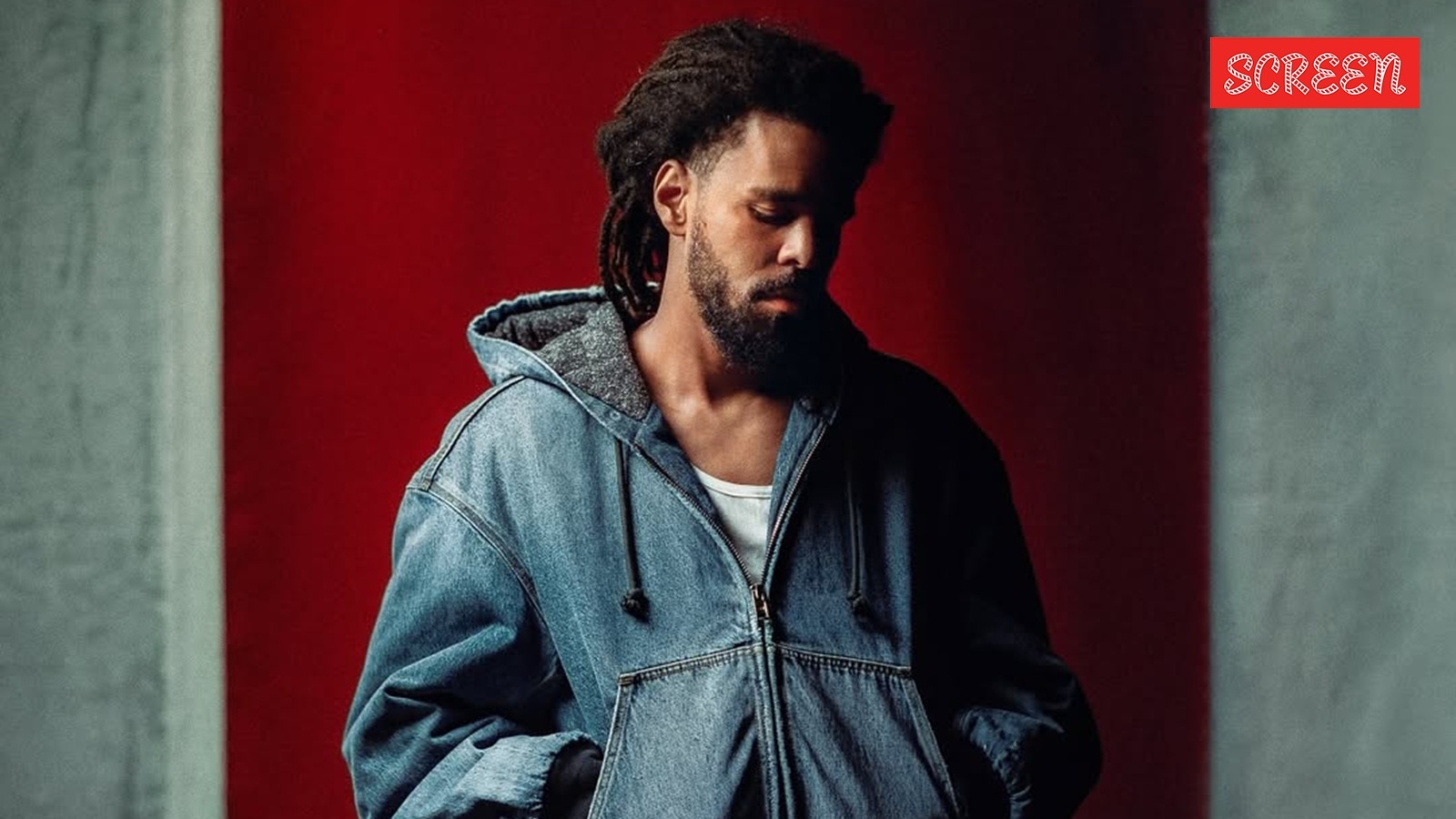
The Falloff Album Review: In a world that constantly seeks summaries, shorter videos, sharper ideas, and a life ruled by brevity, it’s refreshing to see or hear a man who doesn’t care about any of that. American rapper J Cole released his new album, The Fall Off, and it is a summary of the kind of life he has led since he decided to leave his humble town of Fayetteville, North Carolina, for the big lights of New York City. It’s deeply personal and the structure is well thought out. Each song somehow manages to retain an identity of its own while also successfully fitting into the grand scheme of things.
It’s a double album, with two different parts called Disc 29 and Disc 39. The first is from the perspective of a 29-year-old man, and the second (which is self-explanatory) is from the point of view of 39-year-old Cole. You can see how the tone and mood of the album changes as it proverbially ages throughout the album. The brash voice of rebellion seems to slowly calm down and learn to stay calm, while reminding people of the strength they have.


From the beginning, tracks like “Two Six” and “Safety” show the kind of duality that J Cole has always possessed. The former is a high-octane song to brag about, while the latter seems to get you closer to Cole’s success. Cole uses the character of a friend, who wonders if the rapper is now too old to keep in touch with the people who supported him in the early days. The premise of the question suggests that Cole is successful, but not in a way that sounds like any other song in any other mumble rapper’s discography. It’s genuine because it’s connected to a real relationship, and the classic boom-bap beat, with raw percussion, fits the message. It’s raw, real and no-frills, like your relationship with a childhood friend.
He even goes ahead and apologizes to a real-life friend he once had for discriminating against him for being an uninformed teenager. That angry teenager, who knows he’s made mistakes, raps with fear and guilt in the following songs (take the chorus of ‘Run a Train, for example). He addresses his altercations with rappers from his hometown who want to get him into trouble, no matter what. Cole tries to express the fact that even though he doesn’t want to get involved in disputes or fights, people keep trying to lure him back. But unlike Michael Corleone in The Godfather 3Cole’s mastery of the instrumental and his focus on storytelling rather than forced punchlines prove that he’s ready for a fight if the time comes.
In the next few songs, Cole addresses topics like police brutality and racial discrimination, but the moment he starts to sound like he’s preaching, he switches it up with a song like “The Let Out.” The song’s treatment, full of melodic choruses and electric guitar, sounds like something Dr. Dre and Eminem would come up with in the early 2000s. He sings throughout the story like Marshall, and it’s beautiful.
Going into Disc 39, you realize that J Cole isn’t necessarily trying to suppress some of his teenage instincts. There are still songs like “The Fall Off is Inevitable”, where it tears you apart with a story that goes backwards. It begins with the event of his death, moving through events such as winning awards, the birth of his son, meeting his wife, performing for the first time, and being born. Although the structure is limiting, because you suddenly can’t start talking about Bentleys and Benellis (sorry, Future), it feels extremely natural.
Story continues below this ad.
The entirety of the second album is about a man who has seen the top of the world, so material gains don’t matter, nor do platinum records. He tells heartbreaking stories, like losing his friend to gun violence, and how that lives rent-free in his brain: the event and its aftermath.
For those who like a calmer, more relaxed Cole, songs like “Life Sentence” and “I Love Her Again” are a big help (not that kind of life sentence). It reminds you of the Cole you heard on the 2014 album Forest Hills Drive, a Cole who takes the time to acknowledge the love he receives amidst all the chaos of his life in general. He raps like a grown man who’s been thrown to the pavement too many times but one who no longer blames others.
As the album comes to a close, although I wish it didn’t, one can’t help but appreciate that Cole still refuses to forget where he came from. The song “And the whole world is Ville” begins with the phrase: “What I represent until death is where I took my first steps. At the same time, my mother felt the earth tremble beneath her.” I mean, the man keeps saying this is his last album, but he still hasn’t abandoned the city that formed him.
When it’s all said and done, The Fall Off is one of the definitive hip-hop albums of the last decade, maybe more so. It keeps you hooked for 24 songs and makes you walk in J Cole’s shoes 24 times. The first words on Cole’s first full-length album were: “Have you ever prayed for anything in your entire life?” If this is truly his last album and he prayed for hip-hop immortality, he got it and no one can take it away from him.