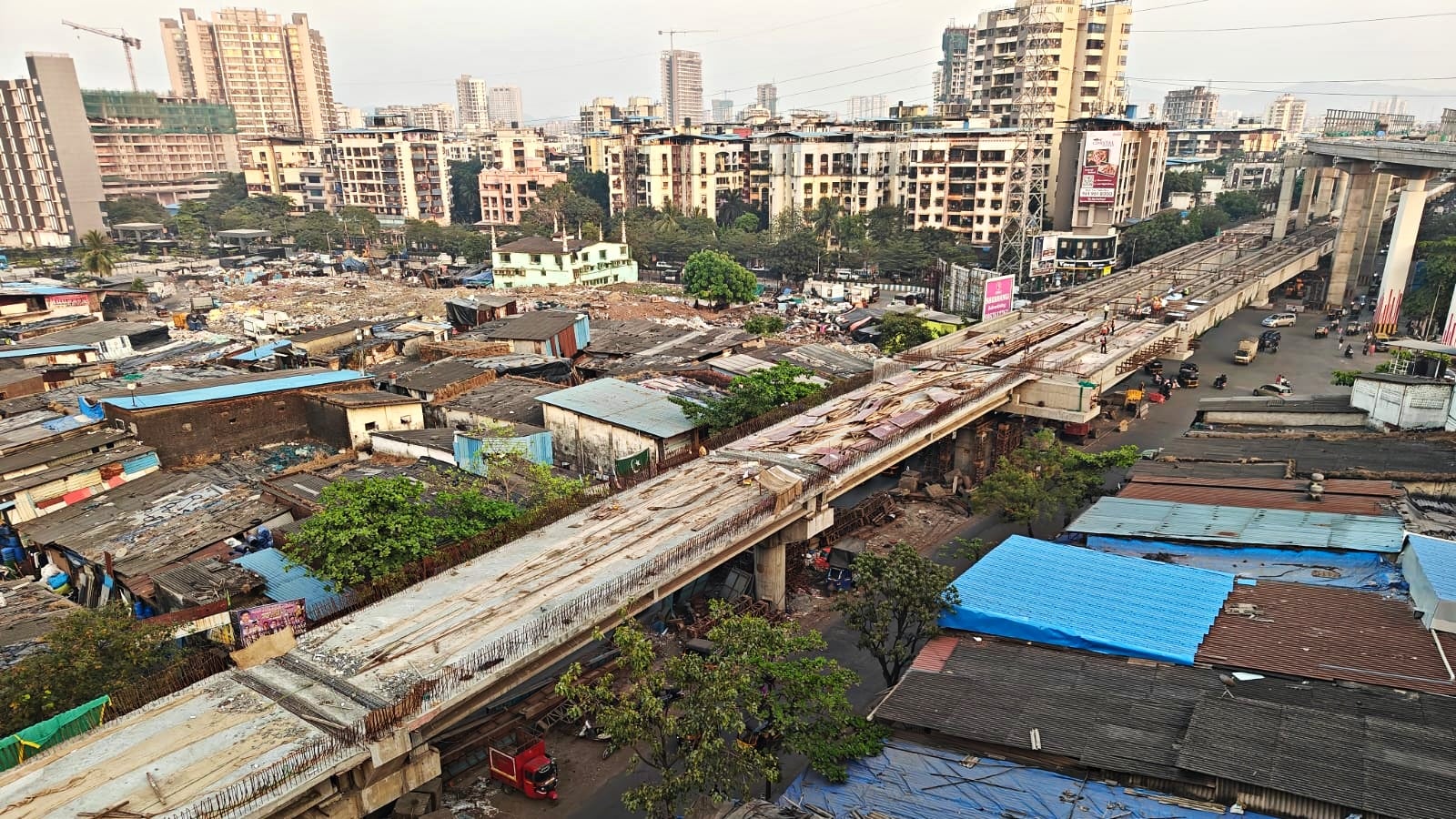
A newly constructed flyover at Mira Bhayandar that narrows abruptly from four lanes to two lanes has drawn criticism over its design and raised safety concerns. SABAH VIRANI explains the concerns surrounding the flyover and the response of the agency that built it.
WHAT THE OVERFLIGHT IS PART OF
The overpass runs along Metro Line 9, which is close to its inauguration. It connects Mira Bhayandar Road with Golden Nest Circle at Bhayandar, one of the busiest junctions in the area where five roads meet and traffic remains heavy throughout the day.

According to the Bombay Metropolitan Region Development Authority, the flyover aims to reduce congestion on Mira Bhayandar Road by providing a grade-separated route for vehicles traveling towards Bhayandar.
Local residents have questioned the design, pointing out that the flyover narrows dramatically when it joins Metro Line 9 near the Shaheed Bhagat Singh Garden station.
THE MMRDA RESPONSE
In response to the viral video, MMRDA said the lane transition was intentional and based on physical limitations at the site.
“The transition is based on the limitations of the width of available roads and future network planning,” the authority said in a post on X.
He explained that the drop-off ramps have been kept to two lanes because the right-of-way on the road below is reduced near Railway Phatak Road. According to the agency, narrowing the ramp helps maintain smoother traffic movement at ground level.
Story continues below this ad.
WHY IT BECOME FOUR LANES AND THEN TWO AGAIN
MMRDA said the flyover follows a two-plus-two lane pattern near Golden Nest Circle, where traffic from several directions converges. The structure then splits, with two lanes intended to go towards Bhayandar East and two lanes planned in the future towards Bhayandar West.
“Since the Bhayandar East arm is the first in the alignment, the four-lane configuration is currently converted to two lanes. The remaining two lanes on the outer side are planned as part of the future extension towards Bhayandar West via the Western Railway line,” the authority said.
For now, only the Bhayandar East branch will be operational.
PLANS FOR FUTURE EXPANSION
MMRDA said the flyover has been designed with scope for expansion at a later stage. He added that in the future an additional lane may be built on each side to improve east-west connectivity.
Story continues below this ad.
“Provisions have been maintained for future widening, wherein the outer side of the flyover on both carriageways will be widened with one plus one additional lane to ensure better continuity of east-west traffic,” the authority said.
He added that the proposal is still in the planning stage and will require coordination with the Mira Bhayandar Municipal Corporation and approval from the concerned authorities.
SECURITY MEASURES IN THE FLIGHT PASS
The authority said multiple safety features have been incorporated into the structure to guide drivers through the changing lane pattern and reduce the risks of accidents.
These include rumble strips, lane markers, signage, retroreflective labels, directional panels and safety barriers.
Story continues below this ad.
WHAT HAPPENS NEXT
The flyover is expected to open along with Metro Line 9 and is expected to play an important role in easing congestion on the Mira Bhayandar Road corridor.
However, the unusual lane transition has highlighted the difficulties of fitting large transportation projects into densely built urban areas. Whether the design works smoothly in practice will only be known after the flyover opens to traffic.
For now, MMRDA has maintained that the design is part of a phased plan and that future extensions will address concerns raised by locals.


